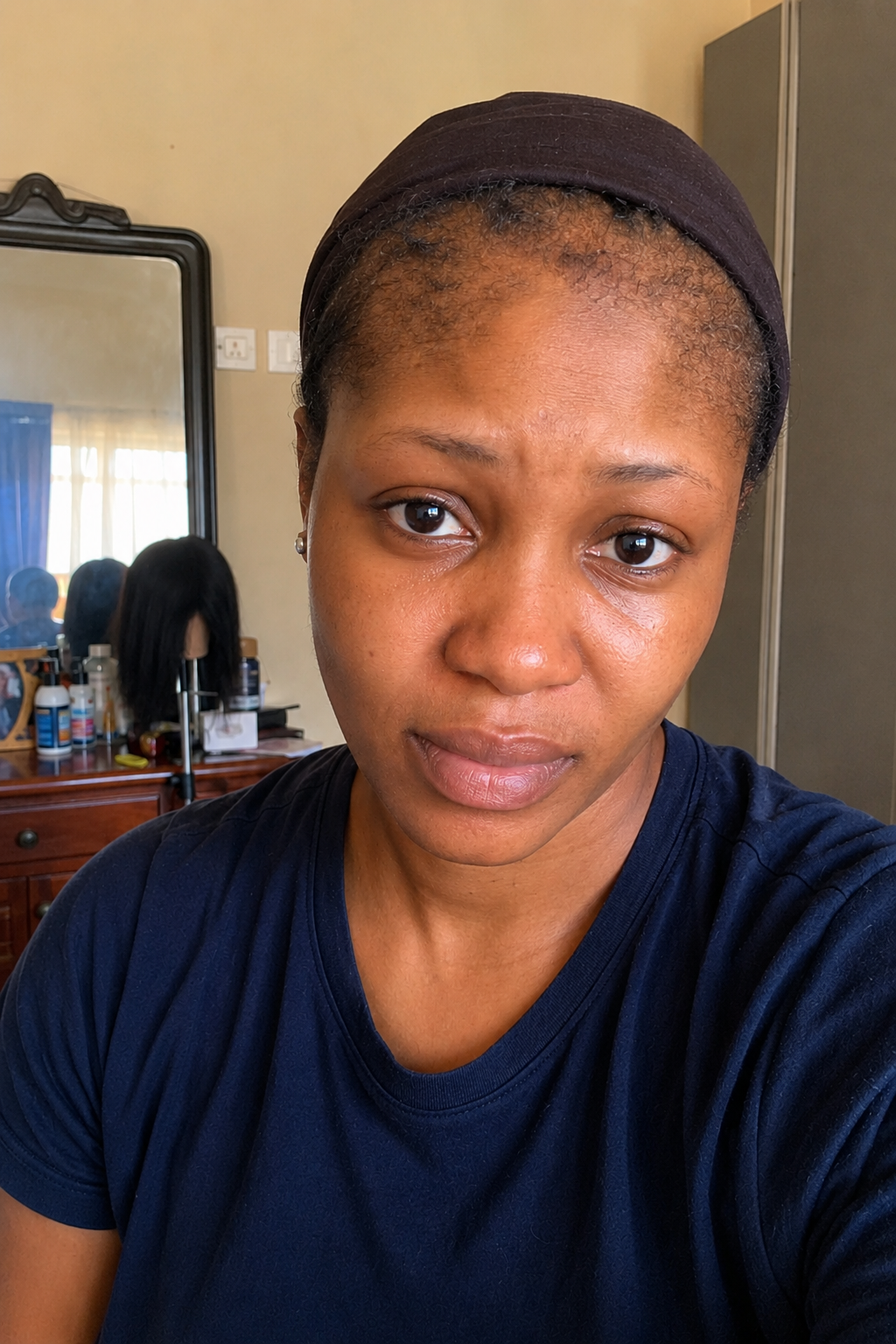
You wake up in the morning… and the first thing you do isn't checking your phone.
It's running your fingers gently along the front of your hairline. Just to confirm what you already know.
That those edges are still there. Or maybe… still disappearing.
"Is it just me, or is it getting worse?"
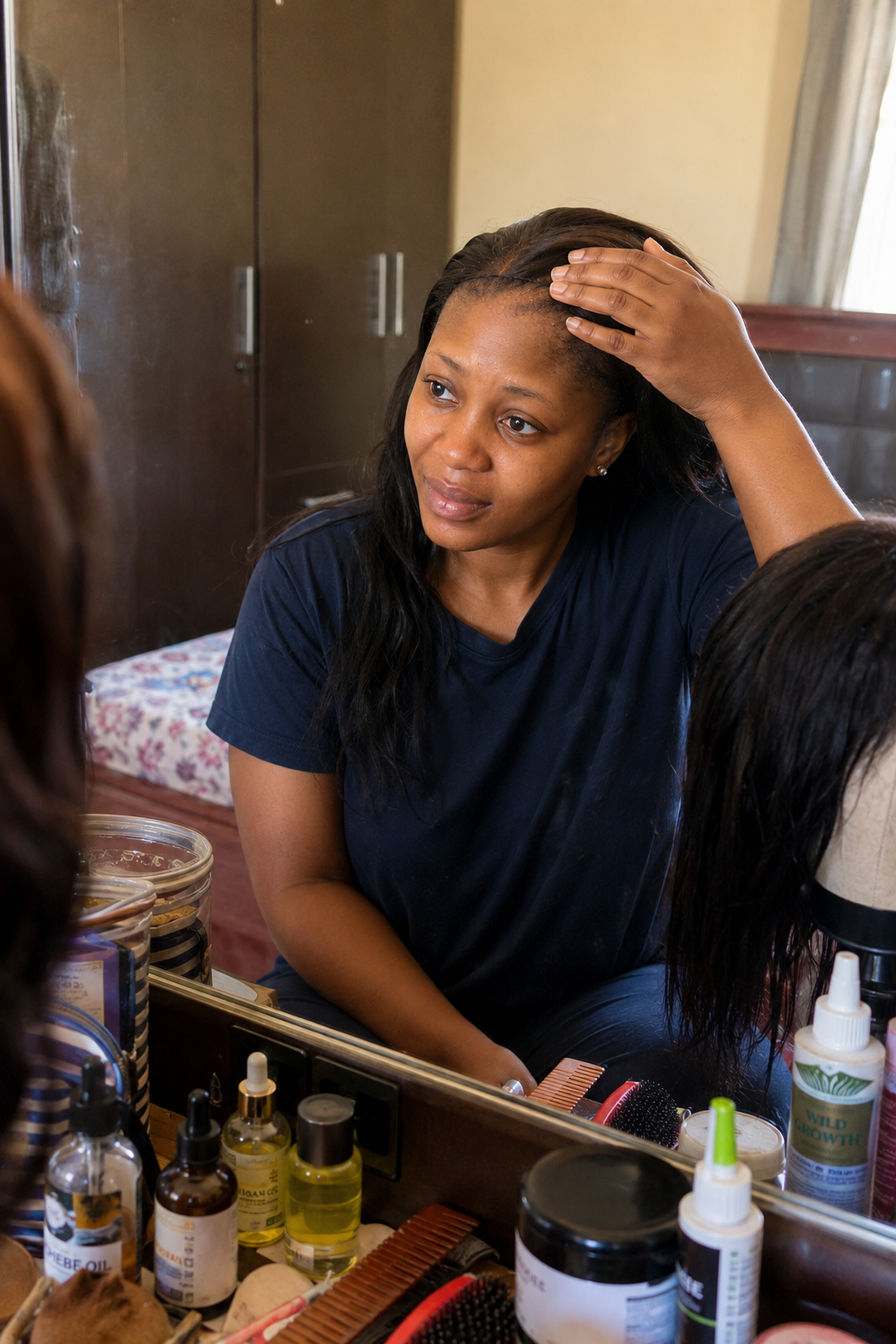
You stand in front of the mirror. You tilt your head left. Then right. You pull your hair back gently with your fingertips just to see clearly. And your heart sinks a little.
Because that small patch near your temple seems wider than last week. The hair in front looks thinner. Almost like baby hair that refuses to grow.
So you reach for your wig. Or your bonnet. Or that small scarf you've been using to cover the area for months now.
You adjust it carefully. Pull it forward. Check the mirror again. Pull it forward some more. And finally, when you're sure no one will notice… you leave the house.
"Please God, don't let any wind blow today."
At work, you avoid certain angles. You sit far from the standing fan. When colleagues take group photos, you politely say "abeg, take it later" and walk away.
You've stopped going for owambe weddings the way you used to. You've turned down beach hangouts. You even avoid your own bathroom mirror at night because you don't want to see the truth too clearly.
And the worst part? You've spent so much money trying to fix this. Oils. Serums. DIY rice water. Onion juice. Salon treatments. "Miracle" growth products from Instagram vendors who never reply your DMs after you pay.
Nothing has worked. Or some things worked small-small for a few days, then your edges still kept disappearing.
If any part of this sounds like you… drop everything you are doing now and listen to every word I'm about to say.
Because I'm about to share with you a simple 30-day ritual that changed everything for me.
This isn't some "new discovery" from a foreign lab.
It's something our grandmothers and great-grandmothers swore by long before lace fronts, bonding glue, and Brazilian wigs ever entered our lives. A method quietly passed down from elder to daughter, from village herbalist to first-time mothers, from old aunties to young brides preparing for their wedding.
The method has been around for decades. But in the rush of modern beauty trends, we somehow forgot it. We replaced it with expensive bottles and fast fixes that just don't work.
Hi, my name is Amara Eze.
And the first thing you should know about me is that I am NOT a doctor. I'm NOT a celebrity stylist. I'm NOT a hair coach. I'm NOT any kind of beauty influencer.
I'm just a 31-year-old banker from Abuja… who saw hell with my own two edges for almost 4 years before I finally found something that actually worked.
Let me start from the beginning.
Back in 2022, I got promoted at the bank. It was a big deal for me. New department, new clients, more visibility. Suddenly I had to look "polished" every single day.
So I did what every Nigerian working woman does. I started wearing wigs Monday to Friday. Lace fronts. Glue. Tight ponytail braids on weekends. Sometimes I'd wear the same wig for two weeks straight without taking it off properly.
At first, my hair was fine. Then six months later, I started noticing my edges looked… different.
Thinner. Sparser. Especially around my temples.
"It's just because I'm tired. Maybe stress. It will grow back."
I told myself that lie for almost two years.
The emotional cost was something I didn't see coming.
My fiancé Tobi, who used to play with my hair when we cuddled on the sofa, stopped doing that. I noticed. I didn't say anything. But I noticed.
I stopped letting him take pictures of me from certain sides. I started wearing my bonnet to bed even on hot Abuja nights so he wouldn't see my hairline up close.
I stopped feeling beautiful. Even in my own home. With the man I love.
Then one morning in early 2024, I went to a salon for a wig install. The stylist — a young girl, maybe 22 — was applying glue along my hairline. She paused. Then she said the words I will never forget.
"Aunty… your edges are really gone o. You sure say make I still gum this one?"
I smiled. I said yes. I paid her. I went home. And I cried in my bathroom for almost an hour.
That night, I called my godmother in Lagos. Aunty Ngozi. The woman who raised me after my mum passed. I told her everything.
She was quiet for a long time. Then she said something that stayed with me:
"Amara, my dear… the thing wey go solve your hair is not for that Instagram. The thing wey go solve am, our mamas know am. Go and ask the old women. They know."
I didn't fully understand what she meant. But I was desperate. So I started searching.
And let me tell you everything I tried. Everything that failed me. Everything that took my money and gave me nothing.
1. Expensive hair oils from Instagram vendors. I bought at least six different ones over those years. ₦8,500 here. ₦12,000 there. One of them was ₦18,000 for a tiny bottle. They all smelled nice. They all promised "instant growth in 7 days." None of them did anything except make my pillowcase greasy.
2. Tight "protective styles". Knotless braids. Box braids. Cornrows. Everybody said braids would "give my hair a break." Nobody told me that pulling my edges tight every two weeks was actually making the damage worse. By the time I removed each set, my hairline looked emptier than before.
3. Rice water DIY treatments. I watched every YouTube video. I fermented rice water for days like a chemistry experiment. I sprayed my scalp every night. After 6 weeks I had zero results. Just a sour smell that wouldn't leave my pillow.
4. Onion juice scalp mixtures. Ah, this one. I cried while blending. I cried while applying. My whole flat smelled like jollof rice for two weeks. And my edges? Still gone.
5. Salon "growth" serums. Some of them burned my scalp. One of them gave me small bumps. The stylist swore "it's the product working" — but I knew burn pain when I felt it.
6. Hair vitamins from foreign brands. ₦25,000 for a small bottle. I took them religiously for 3 months. My nails grew. My hair? Nothing.
By early 2025, I had given up. I made peace with the fact that I would just be a "wig girl" for life.
Then in March of that year, my cousin Chinwe got married in Enugu.
And that's where everything changed.
The wedding was beautiful. Traditional. Loud. Lots of dancing, lots of food, lots of aunties pinching my cheeks and asking when I'm "bringing my own husband home."
In the middle of all the celebration, I went to a small back room to adjust my wig. I had been dancing too hard and I could feel it shifting.
I didn't know anyone was watching me.
An older woman walked in slowly. Maybe 67 years old. White hair, dark wrapper, gold earrings. She had this calm presence that made me feel small in a comforting way.
She stood beside me as I struggled with the wig. Then very gently, she touched my shoulder.
"My daughter… how long have you been fighting this?"
I froze. I didn't know who she was. I didn't know how she knew. But the way she said it… so kind, so without judgement… I just burst into tears right there.
Her name was Mama Adaobi. A retired hair therapist and herbal scalp specialist from Enugu. She had spent over 40 years helping village women, brides, new mothers, and city girls just like me recover damaged hairlines using traditional African scalp-care practices.
She sat me down on a low stool. She removed my wig completely. She looked at my scalp under the yellow bulb in that small room. And she shook her head softly.
Then she said:
"All these oils you young girls are buying… all these onion mixtures… all these tight braids you call protection… they are not the answer. The answer is simpler than all of them combined. Your scalp is tired, my daughter. It is not asking you to add more things. It is asking you to remove the wrong things. Then it can breathe. And when scalp breathes well, edges come back. That is what our mothers knew."
She then explained the full method to me. It took her maybe 25 minutes. No notebook. Just from her memory of teaching it for decades.
It was a simple 30-day routine focused on five things: reducing daily hair tension, improving scalp circulation, restoring moisture balance, correcting damaging styling habits, and using natural scalp-support routines consistently.
Honestly? When she finished explaining, my first thought was:
"This is too simple. There's no way this will work. I've spent over ₦300,000 on products and nothing worked. How can this small routine succeed?"
But Mama Adaobi just smiled like she had heard that doubt a thousand times before. She wrote everything down on a small piece of paper. She handed it to me. And she said, "Try it for 30 days. Then come back and tell me."
I started the very next morning back in Abuja.
Day 1. Day 2. Day 3. Nothing visible. I almost gave up on Day 4 because I felt like I was wasting my time again.
But by Day 6, something happened. When I combed my hair gently that morning, I noticed something. There was way less hair on my comb than usual. Normally I'd lose a small ball of hair every morning. That day? Maybe 5 strands.
I stopped. I looked at the comb. I almost screamed.
By the second week, I noticed something else. The skin along my hairline didn't look so… flat anymore. There was the tiniest sign of new hair coming through. Soft. Baby-fine. But it was there.
By Day 21, I stopped wearing my bonnet to bed because I wasn't ashamed anymore.
By Day 30, when wind blew across my face on a walk, I didn't panic. I didn't run to fix my wig. I just smiled.
Then came the real test.
It was a Tuesday evening. Tobi and I were watching a movie. He was eating groundnut. I was lying on his chest. Then suddenly he sat up, looked at the side of my face very carefully, and said:
"Babe… wait. Your edges are actually growing back. What exactly have you been using?"
I started laughing and crying at the same time. I couldn't even talk. He kept asking. I just kept laughing.
That was the moment I knew. Mama Adaobi was right. Our mothers really did know.
A few weeks later, I went back to Enugu to thank her properly. While I was there, I met three other women she had taught the same routine. Their stories blew my mind.
Ifeoma from Owerri — a mother of three whose hair started thinning after her last child. She told me she got her edges back in about 5 weeks. Her husband bought her a new gele just to celebrate.
Adesuwa from Benin City — a 28-year-old teacher who had been wearing wigs since university. She said by Day 18, her younger sister noticed and asked her what she was doing differently.
Tessy from Aba — a 35-year-old trader with twins. She said the routine didn't just bring her edges back; it gave her back her confidence to take photos again.
That's when I knew this couldn't stay private anymore. Too many women were silently suffering exactly like I had been. And the answer had been sitting in our culture all along.
After I started sharing what Mama Adaobi taught me, the messages started flooding in.
Friends. Friends of friends. Colleagues. Strangers on Instagram who somehow got my number. Everyone wanted me to teach them the exact routine.
For a while I would explain it on long voice notes. But it became too much. I couldn't keep up.
So I sat down with Mama Adaobi's permission and her blessing, and I put everything — the full routine, the list of ingredients to look for, the exact daily steps, the timing, what to avoid, how to know it's working, and how to maintain your results long-term — into one simple, easy-to-read guide.
I called it after the woman who started teaching this long before I was born.
Instant download after payment. Pay safely by card, bank transfer, or USSD.